
SOLUTIONS · AGENTIC AI

Give Your Agents Memory That Works

Store, retrieve, and reason over context with vector search. Drop Qdrant into your agent's retrieval loop in under 10 minutes.

agent_memory.py

from qdrant_client import QdrantClient
from qdrant_client.models import Filter, FieldCondition, MatchValue

# Connect to Qdrant
client = QdrantClient("localhost", port=6333)

# Agent retrieves relevant context
results = client.query_points(
    collection_name="agent_memory",
    query=embed(user_message),
    query_filter=Filter(
        must=[
            FieldCondition(
                key="session_id",
                match=MatchValue(value=session)
            )
        ]
    ),
    limit=5
)

# Feed context to LLM
context = [r.payload["text"] for r in results.points]

Trusted by

Lyzr logo
Dust logo
Voiceflow logo
TrustGraph logo

HOW IT WORKS

Three Steps to Agent Memory

No infra team required. Go from zero to production retrieval in a single session.

01
Store Context

Embed and upsert conversation history, documents, tool outputs, or any unstructured data your agent needs to remember.

client.upsert(collection, points)
02
Retrieve with Filters

Combine semantic similarity with metadata filters (session, user, timestamp, tool) to get precisely scoped context every query.

client.query_points(query, filter)
03
Feed to Your LLM

Inject retrieved context into your agent's prompt. Qdrant handles relevance ranking so your LLM generates grounded responses.

messages += [{"role": "system",...}]
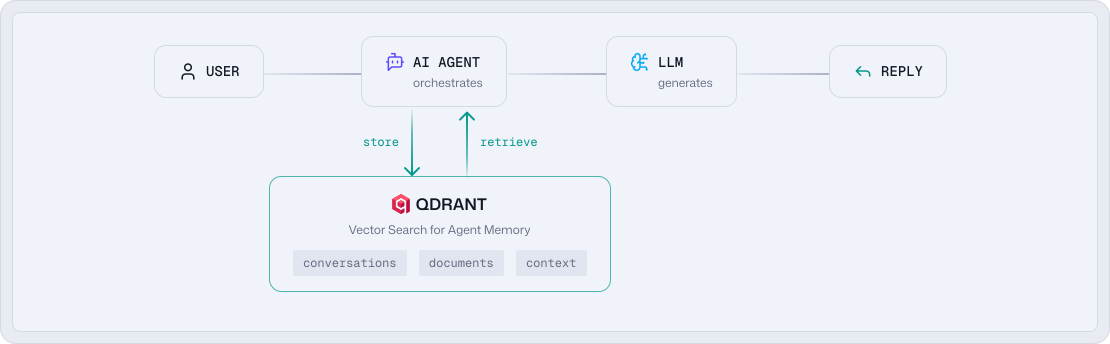
Vector Search for Agent Memory

BUILDER PATTERNS

What Developers Build with Qdrant

Common agent architectures and the retrieval patterns behind them.

Retrieval-Augmented Generation

Your agent queries Qdrant for semantically relevant documents, passes them as context to the LLM, and generates grounded answers instead of hallucinating. Use hybrid search (dense + sparse vectors) to catch both semantic meaning and exact terms. Add payload filters to scope retrieval by source, date, or access level.

rag_agent.py

# Hybrid search: dense + sparse
results = client.query_points(
    collection_name="knowledge_base",
    prefetch=[
        Prefetch(query=dense_vec, using="dense", limit=20),
        Prefetch(query=sparse_vec, using="sparse", limit=20),
    ],
    query=FusionQuery(
        fusion=Fusion.RRF
    ),
    limit=5
)
75%

Dust reduced RAM usage by 75% after migrating from in-memory retrieval to Qdrant for production RAG.

Real-Time Voice Agents

Voice agents can't tolerate latency. Every millisecond in the retrieval loop compounds into awkward pauses. Qdrant's Rust-based engine delivers sub-25ms P99 retrieval so your conversational agent stays responsive.

Filter by session and speaker to retrieve only the current conversation's context without cross-talk between concurrent calls.

voice_agent.py

# Low-latency session-scoped retrieval
context = client.query_points(
    collection_name="call_memory",
    query=embed(transcript_chunk),
    query_filter=Filter(
        must=[
            FieldCondition(
                key="call_id",
                match=MatchValue(
                    value=active_call
                )
            )
        ]
    ),
    limit=3
)
25ms

Tavus achieved 25ms retrieval for conversational AI without awkward pauses.

Customer Support Agents

Index your knowledge base, past tickets, and product docs. The support agent retrieves the most relevant resolution on the first pass, avoiding the loop-and-retry pattern that frustrates users. Use Qdrant's multi-tenancy (payload-based partitioning) to isolate each customer's data without deploying separate collections.

support_agent.py

# Tenant-isolated knowledge retrieval 
answer = client.query_points(
    collection_name="support_kb",
    query=embed(ticket_text),
    query_filter=Filter(
        must=[
            FieldCondition(
                key="tenant_id",
                match=MatchValue(
                    value=org_id
                )
            )
        ]
    ),
    limit=5
)
90%

Lyzr reduced latency by 90% serving support agents on Qdrant.

Recommendation Agents

Embed user behavior, product attributes, and content metadata into Qdrant. Your recommendation agent queries with the user's current context and gets semantically relevant suggestions, not just collaborative filtering. Combine dense embeddings with sparse keyword vectors for hybrid recommendations that understand both "similar style" and "exact feature match."

rec_agent.py

# Discovery: find items unlike dislikes
recs = client.discover(
    collection_name="products",
    target=user_preference_vec,
    context=[
        ContextPair(
            positive=liked_item_id,
            negative=disliked_item_id,
        )
    ],
    limit=10
)
1B+

Tripadvisor searches across billions of user-generated content pieces with Qdrant.

Multi-Agent Shared Memory

Multiple agents (planner, researcher, executor) write to and read from a shared Qdrant collection. Each agent tags its outputs with role and step metadata, so downstream agents retrieve only the context they need.

Use payload filters to scope reads by agent role, workflow step, or timestamp to prevent context pollution across agents.

multi_agent.py

# Executor reads planner's output
plan = client.query_points(
    collection_name="workflow_memory",
    query=embed(current_task),
    query_filter=Filter(
        must=[
            FieldCondition(
                key="agent_role",
                match=MatchValue(
                    value="planner"
                )
            ),
            FieldCondition(
                key="workflow_id",
                match=MatchValue(
                    value=wf_id
                )
            )
        ]
    ),
    limit=10
)
4x

Voiceflow runs managed RAG on Qdrant, powering multi-step conversational workflows at scale.

rag_agent.py

# Hybrid search: dense + sparse
results = client.query_points(
    collection_name="knowledge_base",
    prefetch=[
        Prefetch(query=dense_vec, using="dense", limit=20),
        Prefetch(query=sparse_vec, using="sparse", limit=20),
    ],
    query=FusionQuery(
        fusion=Fusion.RRF
    ),
    limit=5
)
75%

Dust reduced RAM usage by 75% after migrating from in-memory retrieval to Qdrant for production RAG.

voice_agent.py

# Low-latency session-scoped retrieval
context = client.query_points(
    collection_name="call_memory",
    query=embed(transcript_chunk),
    query_filter=Filter(
        must=[
            FieldCondition(
                key="call_id",
                match=MatchValue(
                    value=active_call
                )
            )
        ]
    ),
    limit=3
)
25ms

Tavus achieved 25ms retrieval for conversational AI without awkward pauses.

support_agent.py

# Tenant-isolated knowledge retrieval 
answer = client.query_points(
    collection_name="support_kb",
    query=embed(ticket_text),
    query_filter=Filter(
        must=[
            FieldCondition(
                key="tenant_id",
                match=MatchValue(
                    value=org_id
                )
            )
        ]
    ),
    limit=5
)
90%

Lyzr reduced latency by 90% serving support agents on Qdrant.

rec_agent.py

# Discovery: find items unlike dislikes
recs = client.discover(
    collection_name="products",
    target=user_preference_vec,
    context=[
        ContextPair(
            positive=liked_item_id,
            negative=disliked_item_id,
        )
    ],
    limit=10
)
1B+

Tripadvisor searches across billions of user-generated content pieces with Qdrant.

multi_agent.py

# Executor reads planner's output
plan = client.query_points(
    collection_name="workflow_memory",
    query=embed(current_task),
    query_filter=Filter(
        must=[
            FieldCondition(
                key="agent_role",
                match=MatchValue(
                    value="planner"
                )
            ),
            FieldCondition(
                key="workflow_id",
                match=MatchValue(
                    value=wf_id
                )
            )
        ]
    ),
    limit=10
)
4x

Voiceflow runs managed RAG on Qdrant, powering multi-step conversational workflows at scale.

INTEGRATIONS

Drop into Your Existing Stack

First-class SDKs and framework integrations. No wrappers, no adapters.

Orchestration Frameworks

LangChain logo
LlamaIndex logo
CrewAI logo
Mastra logo
Haystack logo
No-Code / Low-Code
N8n logo
Flowise logo
Agent Memory
Mem0 logo
Cognee logo
SDKs
Python logo
Typescript logo
Rust logo
Go logo
.Net logo
Java logo
Coding Agents
ClaudeCode logo
Cursor logo
Codex logo
OpenCode logo
Pi logo

DEVELOPER TOOLS

Purpose-Built for Agent Builders

Tools and patterns that make agent memory a solved problem, not a research project.

Start Building with Skills

SKILL.md

# Agent Memory Skill
#
# Give your agent persistent, filtered
# memory using Qdrant as the retrieval
# backend.

# Setup
# pip install qdrant-client

# Collection Schema
# vectors:
#   dense: { size: 1536, distance: Cosine }
#   sparse: { index: { on_disk: true } }
# payload_index:
#   - session_id: keyword
#   - agent_role: keyword
#   - timestamp: integer
#   - tool_name: keyword

# Query Pattern
# Always filter by session_id + agent_role
# Use hybrid (dense+sparse) for knowledge
# Use dense-only for conversation history
Text search

Hybrid search combines dense embeddings with BM25 sparse vectors via reciprocal rank fusion

Filter

Payload filtering scopes retrieval by any metadata field without post-processing

Boxes

Multi-vector support stores ColBERT token-level representations natively

Target

Quantization (scalar, binary, product) cuts memory 4x while preserving accuracy

Git branch

Real-time upserts let agents write new memories without index rebuild delays

29K+

GitHub stars on the open-source engine

250M+

Total downloads across all packages

60K

Developers in our community

<5ms

P95 retrieval latency at production scale

RESOURCES

Start Building

Everything you need to go from prototype to production.

Rocket
Quickstart Guide

Run your first query in under five minutes.

Brain
Agentic Vector Search

Build Performant, Scaled Agentic Vector Search

Git-merge
Hybrid Search Guide

Combine dense and sparse vectors with reciprocal rank fusion for best-of-both retrieval.

Chef hat
Agentic Skills

Use solutions architect knowledge encoded in a format that AI agents can navigate

Gauge
Performance Tuning

Optimize latency, throughput, and memory for production agent workloads.

Building
Multi-Tenancy Patterns

Isolate agent memory per user or organization with payload-based partitioning.

Your Agents Deserve Better Retrieval

Start with the free tier. Scale to billions of vectors when you're ready.

Rocket flying over globe illustration